The completion of this tapestry’s restoration provided the opportunity for a fresh methodological debate aimed at resolving a set of unusual technical and conservation challenges.
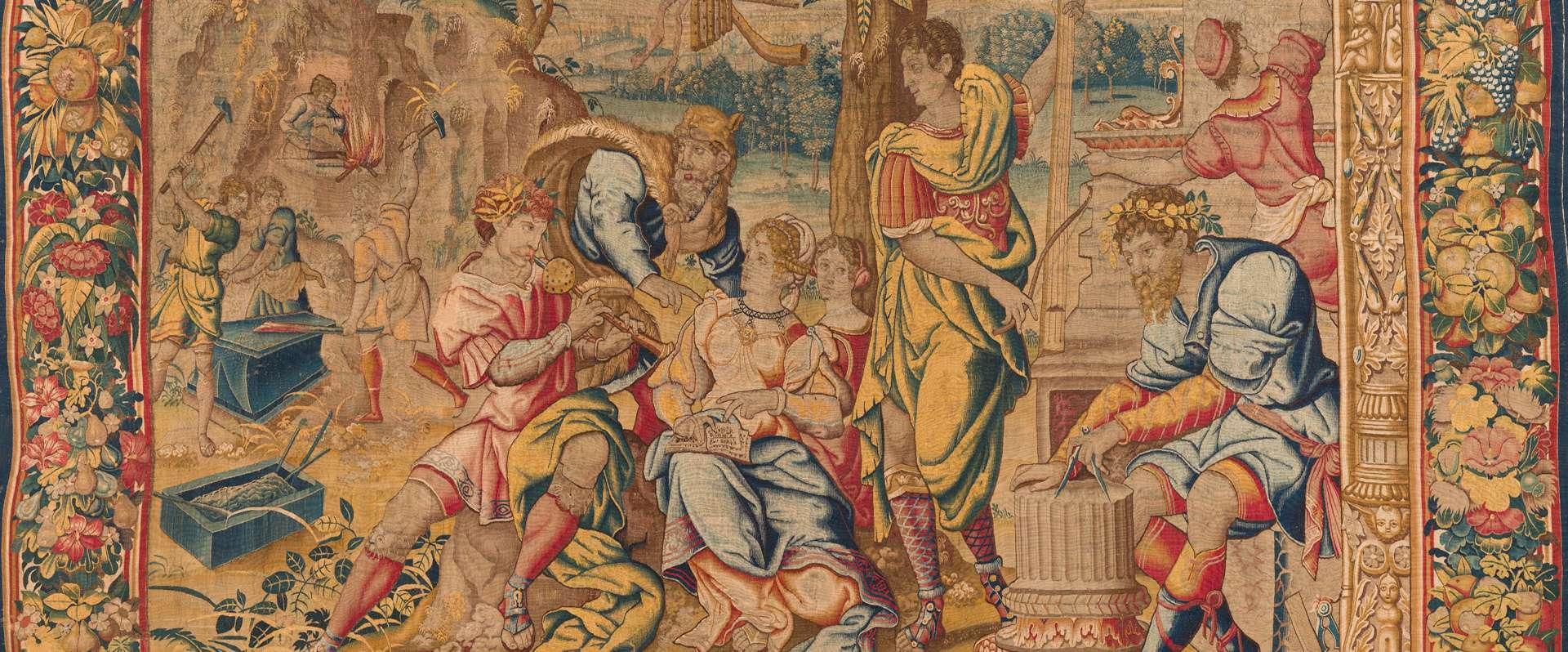
The Invention of the Liberal and Mechanical Arts is part of the Stories of Genesis series — eight panels held at the Museo del Tesoro del Duomo in Modena. The series is of Flemish manufacture, notable for the refinement of its weave and the chromatic vitality of both its figurative scenes and the richly decorated floral-frieze borders. The tapestry depicts the artistic and technological contributions made to humanity by Cain and his descendants (Genesis 4:17–22) — a scene rarely represented, here further enriched by references drawn from classical myth and history.
The work arrived in the laboratory for the completion of a restoration that had been largely carried out by a private studio in the preceding years. The tapestry had already been separated from its lining and reinforcement bands, vacuumed, immersion-cleaned and consolidated through the insertion of all missing warps and new wefts. As a result, the work presented sections in various states: some pre-consolidated with provisional stitching, some fully consolidated, others still undergoing integrative consolidation. The horizontal selvedges were missing entirely; the vertical selvedges were degraded and fragmentary.
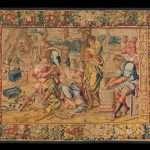
Investigations carried out through microscopic analysis aimed to characterise both original and restoration materials, as well as any deposit materials, in order to understand the object and assess its conservation history — also through comparison with existing prior documentation.
The Opificio’s consolidation work focused on completing the weft integration in the left-hand portion of the tapestry and along the vertical selvedges. The technical and design effort was directed at harmonising the two phases of intervention while minimising impact on the original textile structure. By combining extended-weft integration with the chromatic solutions offered by the mélange technique, it was possible to restore the stability of the textile weave while simultaneously providing chromatic completion to visually significant lacunae — including the border.
Once consolidation was complete, the tapestry was fully backed. The new restoration selvedges, loom-woven, were applied beneath the originals or in place of them where entirely absent. The work has been lined and fitted with a Velcro hanging strip and is awaiting display in the newly refurbished Museo del Duomo.
Next section