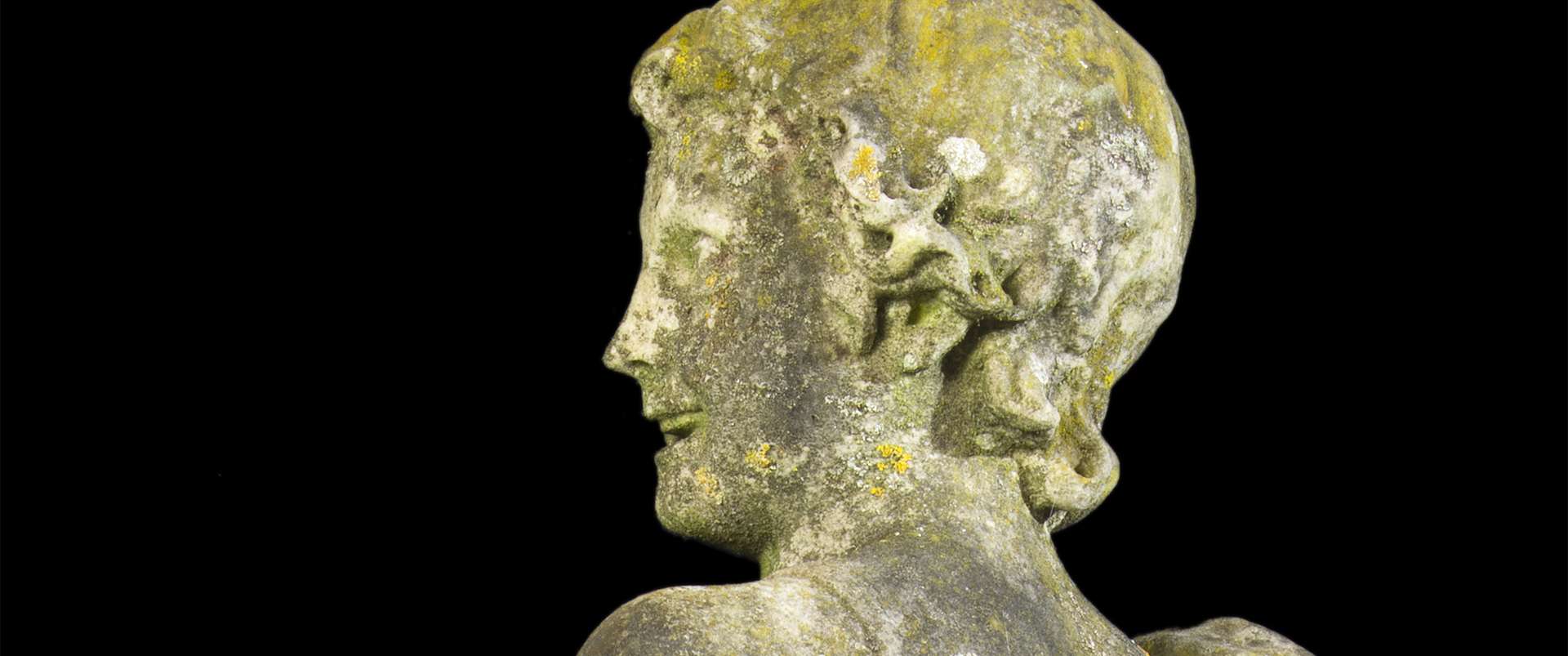
A striking 14th-century sculptural group in organogenic limestone, originally polychrome, consisting of the dead Christ wrapped in his shroud and about to be laid in the tomb, surrounded on three sides by six life-size mourning figures. The ensemble, marked by intense pathos and expressionistic emphasis capable of drawing the viewer into deep emotional engagement, is attributed to the Master of Sant’Anastasia and dated to the first half of the 14th century. It originates from the Church of the Holy Sepulchre in Caprino Veronese, from where it was transferred in 1980, for reasons of safety, to the Museo Civico di Villa Carlotti in Caprino. The work has been cut across its entire lower section — comprising the legs of the mourning figures and the lower part of the shroud and sarcophagus — and retains traces of an early polychromy in several areas.
The organogenic limestone sculptures, originally polychrome, are not carved in the round: the front and sides are fully worked, while the backs show only rough blocking-out marks.
Thermohygrometric conditions, having undergone significant variation over time, represent the primary cause of the deterioration now affecting these sculptural materials. The 2012 earthquake in the Veneto region further worsened an already precarious condition requiring urgent intervention, both active (on the materials) and passive (on the environment). The most recent seismic events caused new damage to the sculptures, and a wooden protective cage was consequently built around each figure to secure them. The deterioration present may be summarised as follows: near-total loss of polychrome surfaces, extensive soluble salt deposits, cracking, fracturing, powdering of the material, loss of fragments and flakes, detachment of significant elements, and losses.
The crude evidence of the mutilation inflicted on the works — an uneven horizontal cut — had reduced them to a series of disarticulated busts. These, with their lower sections variously and severely chiselled away, were marked by cracks and fractures of varying extent and by a widespread process of material decoherence, with the stone crumbling at the slightest touch. Earlier repair work was substantial, comprising fills in cement mortar or plaster — the latter also used for reconstructing missing sections — and various adhesive treatments. The surface was covered by a thick layer of dust and obscured by accumulated lime deposits, through which traces of tempera polychromy occasionally emerged. The data from the investigations carried out indicate that the polychrome statues were gradually stripped of their original colour over time, through repaints applied at dates yet to be established.
The operational phases of the 1980s restoration had focused on the priority of removing soluble salts and consolidating the decoherent stone. These operations were followed by the reassembly of detached sections and the preliminary securing of recovered paint fragments. Cracks and some losses were carefully filled below the surface level. A final consolidant was applied to the porous surface, which had a high absorption rate. During the most recent restoration (2000), salt extraction and deep consolidation of the constituent material were carried out.
The investigations began with an initial examination of the stone surfaces under UV, infrared and false-colour infrared light. Following this phase, areas were identified for non-invasive analysis using portable XRF. Samples were also taken for SEM-EDS and GC-MS analysis. For petrographic investigation, previously detached samples were used and analysed by XRD. Regarding the salts, in addition to analysis to determine their composition, laboratory tests were carried out to establish their deliquescence parameters and to enable the development of an appropriate maintenance plan.
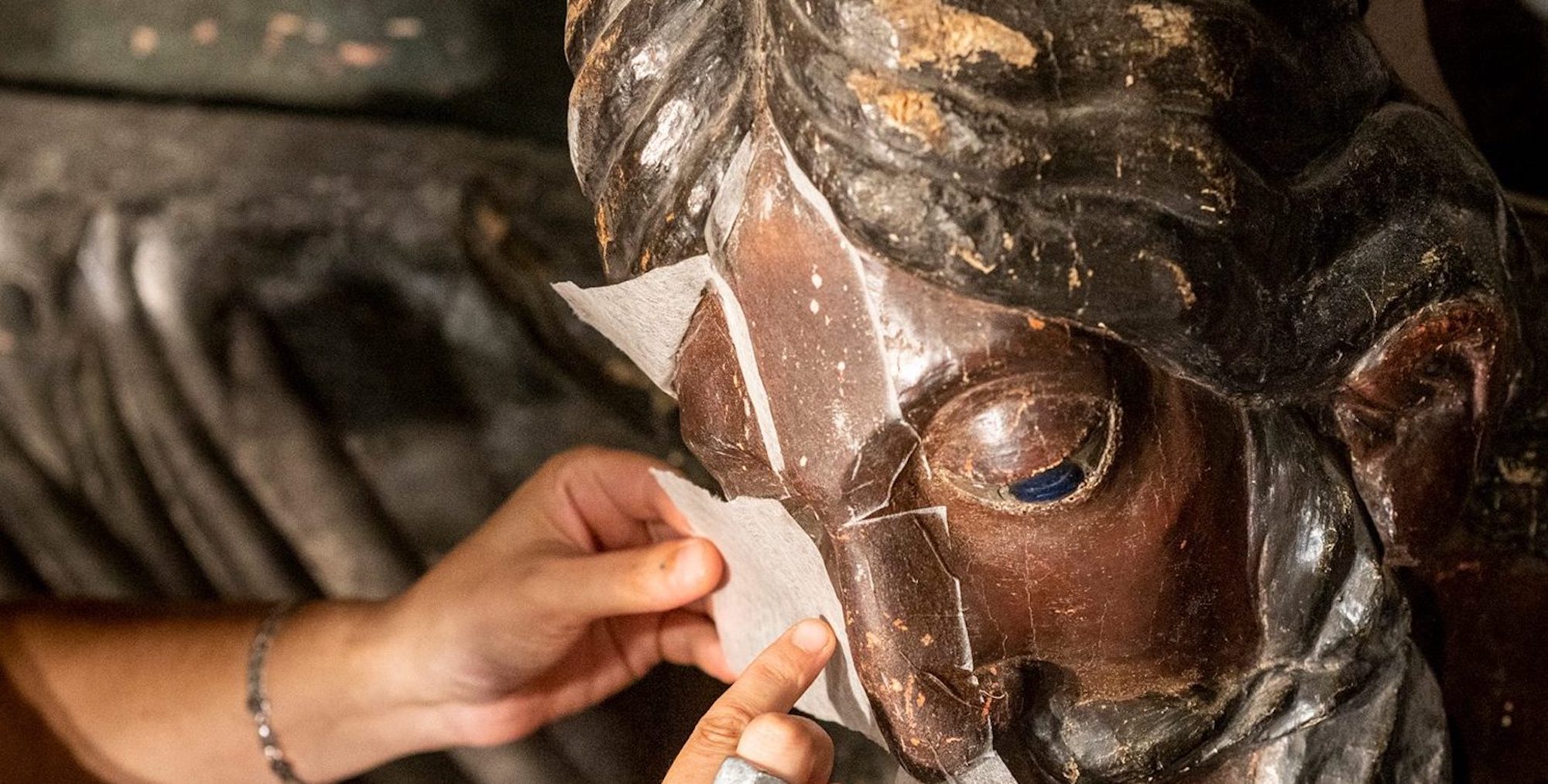
The restoration intervention comprised the following operations: pre-consolidation of the stone and paint layers, concurrent with and/or preliminary to the removal of the facings applied by the Soprintendenza conservator for the transportation of the sculptural group; cleaning; extraction of soluble salts; removal of deposit material and of substances applied in previous interventions; cohesive, adhesive and structural consolidation; securing, cohesion and adhesion of the constituent material and paint layer; insertion of pins or reinforcing material. Filling and integration of discontinuities. Reconstruction of missing sections on the figure of Nicodemus: the fills were produced, following careful study and extensive comparison with contemporary works, on the basis of 3D scanning and subsequent rapid prototyping of the volumes. Design and fabrication of a self-supporting base for each individual work, to ensure the vertical stability of the bust in safety, derived from three-dimensional surface scanning of the sculptures. Study and identification of the most suitable microclimate for the Mortorio display environment, with ongoing monitoring. Planned maintenance and preventive conservation programme.
Next section